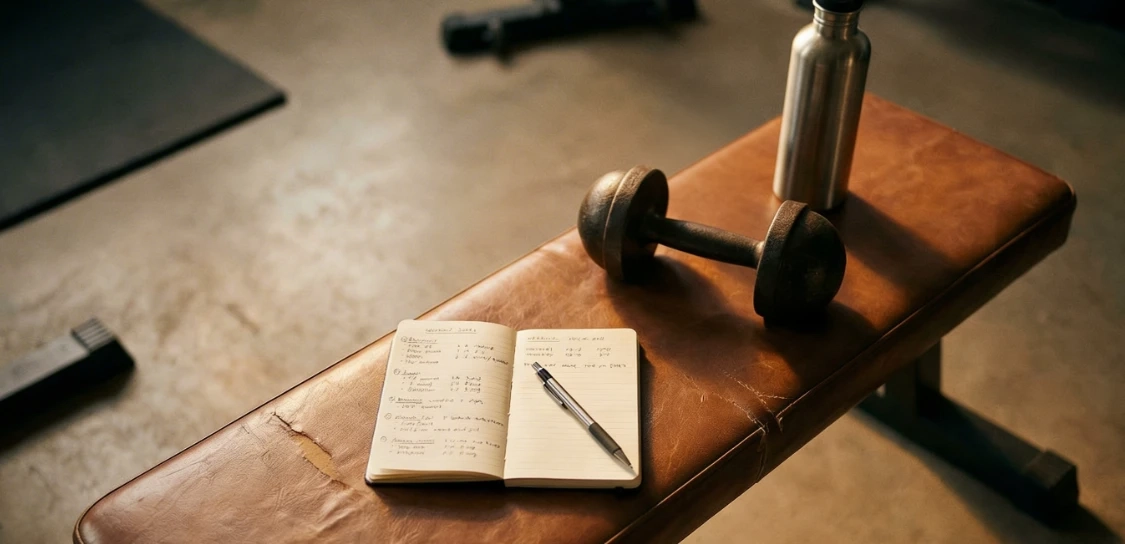
Here's something nobody wants to hear: if you can't tell me what you squatted two Thursdays ago — weight, sets, reps, how it felt — you're not really training. You're just showing up.
That's not a dig. Most people at the gym work hard. But hard work without direction is just cardio with extra steps. The thing that separates people who look the same year after year from people who actually get stronger is almost never effort. It's information.
Specifically: did you do more than last time?
That question — and your ability to answer it — is the entire point of a workout log.
The one principle that matters
Progressive overload. You've probably heard the term. It means gradually increasing the demand on your body over time. More weight, more reps, more sets, or less rest. Something has to change, or your body has no reason to adapt.
The concept is simple. Executing it is where people fall apart, because execution requires knowing what you did before. And that's where your memory fails you.
You did bench press last Monday. Was it 70kg or 72.5? Three sets of eight, or did you get nine on the first set and only seven on the third? Did you rest two minutes or four?
You don't remember. Nobody does. And so you load the same weight, do roughly the same reps, and wonder why nothing changes.
A log fixes this. Not because logging is magic — because it removes the guessing.
What to actually write down
Here's where people overthink it. You don't need a spreadsheet with twelve columns. You need four things:
1. The exercise. Be boringly consistent with names. "Bench Press" is not the same entry as "Flat Bench" or "BB Bench." Pick a name, use it every time. Future-you will thank present-you when searching for history.
2. The weight. What you actually lifted, not what you planned to lift. In kilos or pounds — pick one and commit.
3. Sets and reps. The real numbers. Not "3×10" when you actually did 10, 8, 7. Those drop-offs matter. They tell you the weight might be too heavy to progress on, or that you need more rest between sets.
4. How hard it was. This one's optional but powerful. A simple 1-10 scale — called RPE, or Rate of Perceived Exertion — where 10 means absolute failure and 7 means you had three reps left. Once you get a feel for it (takes a few weeks), RPE becomes your best tool for managing fatigue. A set of 5 at RPE 7 one week and RPE 9 the next tells you something is off — even if the weight didn't change.
That's it. Four things. Takes less time than your rest between sets.
What you can skip
Calories burned (every estimate is fiction). Heart rate during lifting (not actionable). Your "mood" or workout rating (too vague). These aren't bad data points, but they add friction to logging and won't change your programming decisions. If you want to track body weight or sleep, do it separately. Keep the workout log focused on the workout.
The part everyone skips: looking back
A log you never re-read is just a list.
The value isn't in the writing — it's in the reading. And you don't need to do it often.
Before each session: check what you did last time for today's exercises. Load the same weight and try to beat it by one rep, one set, or 2.5kg. That's progressive overload in practice. Nothing fancy.
End of each week: take two minutes. Did your main lifts go up? If yes, keep going. If you missed reps or stalled, flag it.
Once a month: zoom out. Are your numbers trending up over the last four weeks? If you're stuck on the same bench weight for a month despite eating and sleeping well, you have a plateau — and your log just diagnosed it. Now you can fix it: add a set, switch rep range, or take a lighter week.
Without a log, a plateau feels like a vague frustration. With one, it's a data point with a solution.
Planning beats winging it
The biggest upgrade you can make to your training isn't a new program — it's writing down what you plan to do before you get to the gym.
Look at your log from last session. Add 2.5kg to your squat, or aim for one extra rep on your rows. Write it down. Now your workout has intent.
This takes two minutes the night before or the morning of. And it means that when you walk into the gym, you're not standing around deciding what to do next — you're executing.
Plan → execute → log → review. That's the loop. The log is what makes it work.
Pick a tool you'll actually use
Paper notebooks work. They're fast and distraction-free. But you can't search them, they don't graph anything, and they get left in gym bags and forgotten.
Spreadsheets work. They're flexible and powerful. But updating a Google Sheet between sets on your phone is painful, and they get messy after a few months.
Apps are the most practical option for most people because you already have your phone at the gym. The key is finding one that lets you log quickly — if it takes more than a few seconds per set, you'll stop using it.
That's why we built FitHero. It does one thing well: lets you log your workout fast. Custom exercises with no limits, no paywalls, no subscription to unlock features. Build your own workouts, track sets and reps in seconds, and see your progress over time. It's free, it syncs to the cloud, and it works offline. If you've been looking for something that stays out of your way and just tracks your lifts — this is it.Start small
Don't try to build the perfect logging system on day one. Just open something — a note, a notebook, an app — and write down what you do in your next session. Exercise, weight, sets, reps. That's all.
Do it again the next session. And the next.
In a month, you'll have data. In three months, you'll have trends. In six months, you'll wonder how you ever trained without it.
The gym rewards consistency. A log is how you prove — to yourself — that you're being consistent in the right direction.